

Share
Related Products
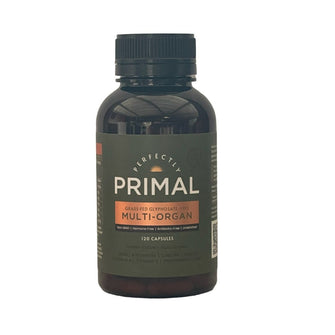
Perfectly Primal Grass-fed Glyphosate-free Non-GMO Multi Organs 120 Capsules
When was the last time you ate liver?
What about heart, kidney or spleen?
If your answer is “I honestly can't remember” — or perhaps “I'd rather lick the floor” — you're certainly not alone. 😂
Organ meats were once a much more common part of our diets. Today, we'll happily eat steak, mince or burgers, but put a kidney on the plate and suddenly everyone has somewhere else they need to be.
Yet nutritionally, organ meats are some of the most nutrient-dense animal foods we can eat.
And as we move through our 40s, 50s and 60s, when nourishing our bodies well becomes increasingly important, perhaps these forgotten foods deserve another look.
Don't worry.
We're not about to give you a liver-and-onions recipe.
What Does “Nutrient-Dense” Actually Mean?
Put simply, nutrient-dense foods provide a high concentration of beneficial nutrients relative to the amount of food or energy they provide.
Organ meats are particularly concentrated sources of several important micronutrients, including iron, zinc, folate and vitamins A and B12.
Liver, in particular, is something of a nutritional overachiever.
Not particularly attractive. Not winning any Instagram food-photography awards. But nutritionally? Impressive.
What Makes Organ Meats So Nutritious?
Different organs provide different nutritional profiles, which is one of the reasons traditional nose-to-tail eating can provide such a broad range of nutrients.
Liver
Liver is naturally rich in vitamin A, vitamin B12, iron, folate and copper.
Heart
Heart provides protein alongside naturally occurring vitamins, minerals and compounds including CoQ10.
Kidney
Kidney provides protein and micronutrients including vitamin B12 and selenium.
Spleen
Spleen is particularly notable as a source of haem iron — the form of iron found in animal foods.
The problem?
Most of us simply don't eat these foods anymore.
If you didn't grow up eating organ meats, there's a fairly good chance you haven't suddenly reached your 40s thinking:
“You know what would really hit the spot tonight? Spleen.”
Why Does Nutrient Density Matter After 40?
Midlife is a good time to become more intentional about nutrition.
Our bodies change. Hormones change. Maintaining muscle and strength becomes increasingly important, and women transition through perimenopause and menopause.
Yet so much of the health messaging directed at women over 40 focuses on what we should remove.
Eat less.
Cut this out.
Avoid that.
Make yourself smaller.
Perhaps we should also be asking:
What does my body need MORE of?
More quality protein.
More plants.
More fibre.
More movement and strength.
And more genuinely nutrient-dense foods.
Are Australian Women Getting Enough Nutrients?
Recent Australian nutrition data gives us an interesting insight.
According to Australian Bureau of Statistics data, 42.2% of Australian women aged 30–49 had an inadequate usual iron intake from food and beverages in 2023.
Importantly, this does not mean 42.2% of women were iron deficient. Dietary intake and diagnosed iron deficiency are different things.
Women's iron requirements also decrease after menopause, which is one reason inadequate intake is considerably lower among women aged 50–64.
Vitamin B12 is another nutrient worth noting. In the same data, 15.9% of women aged 30–49 and 17% of women aged 50–64 had inadequate B12 intake from food and beverages.
This doesn't mean everyone needs an iron or B12 supplement.
It simply reinforces an important point:
Nutrient density matters.
Okay... But I'm Still Not Eating Liver
Fair enough.
Knowing liver is nutritious and actually wanting it for dinner are two very different things.
Enter organ capsules.
Desiccated organ supplements provide another way to incorporate organ-based nutrition without having to source, prepare and eat the organs themselves.
You swallow the capsules.
Your kitchen remains liver-free.
Everyone wins.
Meet Perfectly Primal Beef Multi-Organs
Our Perfectly Primal Beef Multi-Organs provides multiple beef organs in a convenient capsule format for people who appreciate the nutritional value of traditional organ meats but have absolutely no intention of becoming contestants on MasterChef: Offal Edition.
Different organs naturally have different nutritional profiles, so a multi-organ formula offers something different from taking liver alone.
It's traditional nutrition adapted for modern life.
All the organ. None of the frying pan.
Of course, supplements should complement a nourishing diet — not replace one.
Quality protein, vegetables, fruit, healthy fats, fibre, movement, strength, sleep and a varied diet remain the foundations.
But for foods we know are nutritious and realistically aren't going to eat?
Convenience matters.
If you're thinking:
“I was with you right up until kidney...”
We hear you. 😂
That's exactly why organ capsules exist.
A Better Conversation About Nutrition After 40
Women over 40 are constantly being told to eat less, weigh less and fight every visible sign of ageing.
We'd rather talk about nourishment.
More protein.
More strength.
More movement.
More nutrient-dense food.
More sleep.
More laughter.
More connection.
Healthy ageing isn't about desperately trying to turn back the clock. It's about nourishing and supporting the body we have now so we can remain strong, capable and well as we age.
And sometimes the nutritional wisdom we're looking for isn't new at all.
Sometimes...
it's liver.
Who knew? 😂
Want the Organs Without Actually Eating the Organs?
Discover Perfectly Primal Beef Multi-Organs Capsules — traditional whole-food nutrition in a convenient capsule.
Zero liver recipes required.
[DISCOVER PERFECTLY PRIMAL BEEF MULTI-ORGANS]
Always follow the directions on the product label. Supplements should complement, not replace, a varied and balanced diet. If you are pregnant, breastfeeding, have a medical condition, take medication or have concerns about your iron or vitamin status, speak with an appropriately qualified healthcare professional before introducing a new supplement.
References & Further Reading
The information in this article is based on current nutritional research and Australian dietary data. For those who would like to explore the evidence further:
Australian Bureau of Statistics (ABS) — Usual Nutrient Intakes, 2023
Australian data on usual nutrient intake, including iron, vitamin B12, magnesium, vitamin A and other micronutrients across different age and sex groups.
https://www.abs.gov.au/statistics/health/food-and-nutrition/usual-nutrient-intakes/2023
Australian Bureau of Statistics — Iron Intake in Australian Women
The 2023 data found that 42.2% of Australian women aged 30–49 had an inadequate usual iron intake from food and beverages, compared with 9.8% of women aged 50–64.
https://www.abs.gov.au/statistics/health/food-and-nutrition/usual-nutrient-intakes/2023
Australian Bureau of Statistics — Vitamin B12 Intake
The same 2023 Australian nutrition data found inadequate vitamin B12 intake from food and beverages in 15.9% of women aged 30–49 and 17.0% of women aged 50–64.
https://www.abs.gov.au/statistics/health/food-and-nutrition/usual-nutrient-intakes/2023
Disclaimer
This article is provided for general educational and informational purposes only and is not intended to provide medical or nutritional advice, diagnose or treat any health condition, or replace advice from a qualified healthcare professional.
Individual nutritional requirements vary. Supplements should complement, not replace, a varied and balanced diet. Always read the product label and follow the directions for use.
If you are pregnant or breastfeeding, have a medical condition, take medication, or have concerns about your iron, vitamin or nutrient status, please seek advice from an appropriately qualified healthcare professional before introducing a new supplement.


