

Share
Related Products
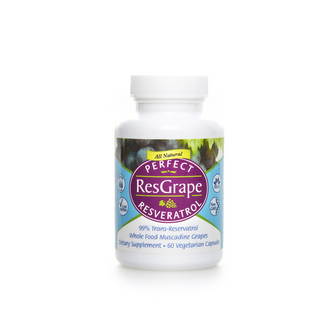
Perfect ResGrape Resveratrol
There comes a point somewhere around 40 when you look in the mirror and think, “Hang on… when did THAT happen?”
Perhaps it’s a new line that definitely wasn’t there last Tuesday. Maybe your skin suddenly feels drier despite using approximately seventeen different serums. Or perhaps the face you see first thing in the morning now requires considerably longer to “wake up” than it did in your twenties.
Welcome to skin after 40.
Hormonal changes, declining collagen production, accumulated sun exposure and oxidative stress can all start becoming more noticeable as we move through our forties, fifties and beyond.
And while we are absolutely here for embracing aging — because the alternative isn't particularly appealing — there’s nothing wrong with wanting our skin to look healthy, vibrant and glowing while we do it.
Enter resveratrol.
This fascinating plant compound has attracted plenty of attention in healthy-aging research, particularly because of its antioxidant properties and potential role in supporting cellular health.
And no, before you ask, this isn't permission to drink an entire bottle of red wine because "it's for my skin."
Nice try.
First Things First: What Is Resveratrol?
Resveratrol is a naturally occurring plant compound belonging to a family of antioxidants called polyphenols.
It's found in foods including red and purple grapes, blueberries, cranberries and peanuts. Grapes produce resveratrol primarily in their skins, which explains why you'll often hear about it in relation to red wine.
But before we pour another glass in the name of longevity, the amount of resveratrol in wine is relatively small and variable.
Most scientific research investigating resveratrol uses much more concentrated amounts — often focusing specifically on trans-resveratrol, the form most commonly studied.
So what makes this little plant compound so interesting?
Quite a lot, actually.
1. Resveratrol Helps Fight Oxidative Stress — AKA One of Skin's Uninvited Guests
Every day, our bodies are exposed to things that generate free radicals.
UV exposure. Pollution. Cigarette smoke. Environmental toxins. Normal metabolic processes.
And then there's stress.
Because apparently worrying about work, family, money, relationships and whether you remembered to take the chicken out of the freezer wasn't enough — stress can also affect our skin.
Wonderful.
Our bodies have their own antioxidant defence systems designed to keep free radicals under control. But when free-radical production overwhelms those defences, we experience something called oxidative stress.
Over time, oxidative stress can contribute to cellular damage and is considered one of the processes involved in skin aging.
Resveratrol acts as an antioxidant, helping to neutralise free radicals and supporting the body's defence against oxidative stress.
Think of antioxidants as part of your body's internal clean-up crew.
And after 40, we'll happily take all the support we can get.
2. Let's Talk About Collagen — Because After 40, Everybody Is Talking About Collagen
Collagen is essentially part of the scaffolding that keeps our skin looking firm, plump and resilient.
When we're younger, our bodies are pretty good at producing it.
Then we get older and our collagen production starts declining.
Rude.
For women, the hormonal changes associated with perimenopause and menopause can make changes in skin structure, hydration and elasticity particularly noticeable.
This is one reason you may suddenly feel as though your skincare routine stopped receiving the memo.
Research suggests resveratrol may influence pathways associated with collagen degradation and oxidative damage.
That doesn't mean taking resveratrol will magically erase wrinkles or turn your skin back to how it looked at 25.
Nor should that be the goal.
Instead, think about healthy aging from two directions: supporting the production of important structural proteins while also helping protect what you've already got.
Collagen and antioxidants can therefore make very good teammates.
3. Resveratrol May Support a Healthy Inflammatory Response
Inflammation is not inherently bad.
It's an essential part of the body's immune and healing response.
However, researchers are increasingly interested in the relationship between persistent low-grade inflammation, oxidative stress and biological aging.
Resveratrol has been studied for its interaction with several cellular pathways involved in inflammatory responses.
For women over 40, this becomes particularly interesting because our skin is dealing with a lot.
Hormonal changes. Environmental exposure. Stress. Less sleep than we'd like. Possibly teenagers. Possibly aging parents. Possibly both simultaneously.
Honestly, our skin deserves a medal.
Supporting the body with antioxidant-rich foods and polyphenols is one way of giving it a little extra nutritional backup.
4. Here's Where Things Get Really Interesting: Resveratrol and Cellular Ageing
Resveratrol became something of a celebrity in the longevity world because researchers discovered that it interacts with cellular pathways associated with ageing.
One area of particular interest involves proteins called sirtuins, especially SIRT1.
Sirtuins are involved in numerous cellular processes, including metabolism, cellular stress responses and DNA maintenance.
This led to considerable excitement around the possibility that resveratrol might influence some of the same biological pathways associated with calorie restriction and longevity.
Before anyone gets too excited, we're not saying resveratrol is an immortality supplement.
If only it were that easy.
Human ageing is incredibly complicated, and no single supplement is going to stop it.
But the relationship between resveratrol, cellular stress responses and healthy aging continues to be a fascinating area of scientific research.
And personally, we'd much rather talk about supporting healthy ageing than "anti-aging."
We're not anti-ageing.
We've worked hard for these years.
We'd simply like to look fabulous while collecting them.
5. Skin Health Is an Inside Job Too
We love a good serum.
We love moisturiser.
And SPF? Non-negotiable.
But we can spend hundreds of dollars on beautiful skincare products and forget that our skin is an organ that also relies on nutrition.
Healthy skin requires protein, essential fatty acids, vitamins, minerals, antioxidants and adequate hydration.
Sleep matters.
Stress matters.
Hormones matter.
Sun exposure matters.
And yes, what we eat matters too.
A colourful whole-food diet naturally provides a huge range of antioxidants and polyphenols, including anthocyanins, carotenoids and flavonoids.
Resveratrol is another member of that nutritional family.
So instead of thinking only about what we're putting on our face, it makes sense to consider what we're providing our skin from within.
6. Resveratrol + Collagen: A Great Healthy-Ageing Combination
If collagen is already part of your daily routine, resveratrol can complement it beautifully because the two nutrients have very different roles.
Collagen provides amino acids and peptides associated with the body's collagen matrix.
Resveratrol provides antioxidant polyphenols that help protect cells against oxidative stress.
And then there's vitamin C, which contributes to normal collagen formation for the normal function of skin.
In other words, instead of hunting for one magical "anti-ageing" ingredient, think about creating a team.
Collagen.
Vitamin C.
Antioxidants.
Plenty of protein.
Healthy fats.
Colourful plants.
Water.
Sleep.
And perhaps fewer occasions where we stay awake until midnight scrolling through our phones wondering why we're tired.
We said perhaps.
Can We Just Eat Grapes Instead?
Absolutely.
Red and purple grapes, berries, cranberries and peanuts can all provide naturally occurring resveratrol alongside many other beneficial nutrients.
But the amount of resveratrol naturally occurring in foods can be relatively small and varies considerably.
That's where supplementation may be useful for people who want a more concentrated source.
When comparing resveratrol supplements, take a look at how much trans-resveratrol the product actually provides rather than being impressed by a giant number on the front of the bottle.
Because supplement labels can occasionally involve a little… creative mathematics.
The biggest number isn't necessarily telling you the whole story.
Can I Just Drink More Red Wine?
This is probably one of the most common questions people ask when they hear about resveratrol. After all, red wine contains resveratrol because it's made from the skins of red grapes. Unfortunately (or fortunately, depending on how you look at it!), the amount found in red wine is relatively small. To consume the amounts of resveratrol commonly used in research, you would need to drink far more red wine than would be considered healthy.
And that's where the idea quickly falls apart. While an occasional glass of red wine can certainly be enjoyed as part of a balanced lifestyle, alcohol itself is a toxin that places extra demands on the liver as it is broken down and eliminated from the body. Excessive alcohol intake is also associated with a range of negative health outcomes. If your goal is to support healthy ageing, glowing skin and overall wellbeing, relying on red wine as your primary source of resveratrol isn't the answer. You're far better off enjoying a diet rich in colourful plant foods and, if appropriate for your individual needs, choosing a high-quality trans-resveratrol supplement.
Ageing Isn't the Problem
There is something incredibly liberating about reaching your forties and beyond.
For many women, we know ourselves better.
We care less about what everyone else thinks.
We understand our bodies more deeply.
We become clearer about what — and who — deserves our energy.
Would we perhaps like the collagen levels we had at 25 to accompany all this newfound wisdom?
Absolutely.
Unfortunately, Mother Nature didn't include that particular upgrade.
So instead of trying to stop aging, perhaps the goal is to age really, really well.
Eat nourishing food.
Lift weights.
Walk outside.
Protect your skin from excessive sun exposure.
Sleep.
Laugh.
Manage stress where you can.
Love people who make you feel good.
And support your body with nutrients that help it continue doing the extraordinary job it has been doing for the last 40, 50, 60 or more years.
Resveratrol isn't the fountain of youth.
Nothing is.
But its antioxidant properties and fascinating relationship with cellular health make it a compelling addition to the healthy-aging conversation.
Because we're not interested in turning back the clock.
We're interested in feeling vibrant, strong and confident — and having gorgeous, healthy-looking skin come along for the ride.


